Details behind Michelangelo's Artistry
After learning about Michelangelo's history and art more in depth in Chapter 13, I wanted to discover more. When doing some more research, I stumbled upon James G. Cooper's article titled, "Michelangelo's Laurentian Library: Drawings and Design Process". I found his art inspiring and I wanted to learn more about the delicate process behind it, which is why I choose this article. Essentially, this article goes into his design process by studying his drawings that survived in the Laurentian Library.
This author carefully studied and replicated many of his sketches in order to truly understand his artistic process. Cooper goes into his sketching process stating, "In all the surviving sheets the drawings are incomplete, and this is because the act of sketching was itself Michelangelo's primary vehicle for exploring and developing an idea. Each sketch inevitably led to a new idea and this led to a new sketch with there being no point in completing the previous one" (Cooper). The article continues to study the ideas and starting points behind his drawings.
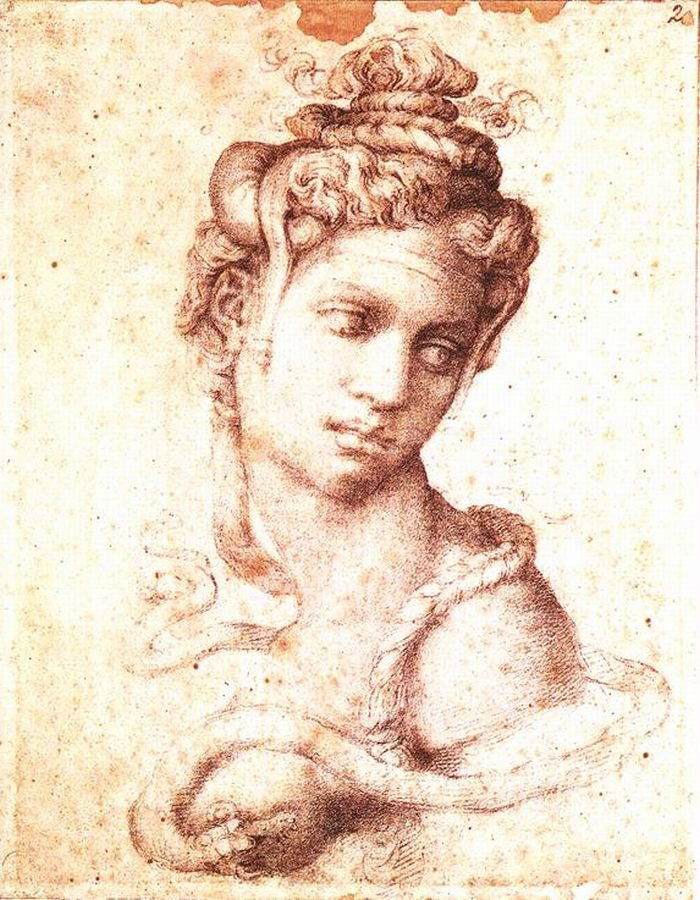 |
Head of Cleopatra Florence, Italy |
While I got most of the history and facts on Michelangelo in Chapter 13, the text did not go into great detail on his design/drawing process as the article did. The Cooper article primarily focused on his said thought process behind his sketches and art. For example Cooper explains, "Michelangelo indented his rapid, freehand sketches to be for his eyes only. In some cases, he appears to have them drawn them so quickly that one can imagine the ideas appearing on the sheet almost as rapidly as they were evolving in his mind" (Cooper). From this article I learned much more about his creative design process, but the text provided me with the overall background information about his life as an artist.When talking about his sculptures the text states, "Michelangelo had hardly begun work on the pope's tomb when Julius commanded him to fresco the ceiling of the sistine chapel to complete the work done in the Previous century.. But Michelangelo resisted the project" (Cunningham). If I had not read Chapter 13, reading all about his drawings from the beginning would have not been as interesting without knowing the details of his life. I am glad I read both of these texts because they provided great information that allowed me to have the best understanding of Michelangelo.
I selected this article by James Cooper because I truly love art. I enjoy drawing/painting and after reading about Michelangelo in Chapter 13, I was curious to know his personal creative process behind his incredible artistry. This article provided me with that information and because of that I was able to compare and contrast my own design process to his, which was very interesting.
Works Cited
COOPER, JAMES G. “Michelangelo’s Laurentian Library: Drawings and Design Process.” Architectural History, vol. 54, SAHGB Publications Limited, 2011, pp. 49–90, http://www.jstor.org/stable/41418348.


I really liked you subject line because i didn't know that Michelangelo had so many unfinished work. I do art and sometimes find it hard to finish work when I get new inspirations while working of pieces to, do you think maybe he had a short attention span? Also, I suggest using one font on your blog next time.
ReplyDelete